A mercifully modest makeover (thank the skateboarders) of these brutalist beauties revives something of their 60s soul, though certain details lack a guiding hand
“If goats could climb over buildings, why couldn’t people?” says Dennis Crompton, veteran of a cell of young tearaways who, ensconced in the architects’ department of the London County Council at the dawn of the 1960s, designed the Queen Elizabeth Hall, Purcell Room, Hayward Gallery and their connecting tissue of walkways on the South Bank in London. Crompton and his colleagues wanted the project to be like theMappin Terraces at London Zoo, of 1913-14, where captive beasts roam over a concrete mountain range, only for humans. Now renovated, a half-century after its completion, the Thameside complex is inching towards being the place that Crompton and his comrades had wanted.
The craggy, layered geology of theSouthbank Centre was conceived as a series of platforms, inside and out, where people might do what they will, unified and solidified by flowing, mouldable concrete. A collage done in 1972 portrayed the architects’ wishes for the by then completed complex. The work of another of the tearaways, Ron Herron, it showed bright colours irradiating the grey video screens, a pink tent, clip-on structures, artificial turf on the decks.
‘Shimmering rhythms of timber’: a detail of the Purcell Room. Photograph: Morley von Sternberg
The way Crompton tells it now, touring the newly restored buildings, their attitude was generally laid-back. Interventions by artistic grandees such as Yehudi Menuhin and Henry Moore had to be accommodated. Some guile was needed to smuggle the radical design into being, under the uncomprehending nose of the head of the department, Hubert Bennett. “We were fairly relaxed about the whole thing,” says Crompton. At the same time, the work has craft and form. Platoons of draftsmen were required to draw the layout of the boarded formwork that left its patterns on the concrete, and platoons of carpenters were required to build it. The essence of the project is its interaction between the fixed and the mobile, artistry and action, permanent and temporary.
Later, something got lost in translation. The terraces came to be seen as inhospitable and obdurate, not least by successive managements of the South Bank. Since the 1980s, a procession of eminent architects, collectively clocking up God knows how much in fees, have produced one grand and ultimately foundering scheme after another, all of them working from the assumption that the place was a terrible failure, in need of livening up, and that the best agent of such livening would be dollops of retail, food and beverage outlets, which conveniently would help pay for the grand designs.
Now, finally, the Hayward and the building that contains both the Queen Elizabeth Hall and the Purcell Room have been renovated – the gallery having reopened in January, the concert halls will follow suit on 9 April – and it turns out that the best thing to do was not very much at all. The architects are Feilden Clegg Bradley Studios, who were first appointed to deliver an overblown, competition-winning scheme of their own. This having gone to the same graveyard as several others, FCBS have instead done a bit of polishing, cleaning and tidying up, and some ad hoc insertion of such things as extra dressing rooms and other back-of-house facilities into the spare, odd, non-specific spaces that the original freeform design generated.
A new QEH dressing room. Photograph: Morley von Sternberg
So the main venues glow with renewed lustre. You can see again what a terrific room is the auditorium of the Queen Elizabeth Hall, with its poised, tuned composition of rough and fine, its sculpted concrete, luxuriant leather seats and shimmering rhythms of timber. Good acoustics, too, say better judges than me. The Hayward Gallery’s exhibition spaces, as previously reported, hum. “It’s amazing, though I say it myself,” says Crompton, of the Hayward’s virtuoso segue of staircases, pillars, beams, ducts and lift shafts, formed out of an orchestrated lava flow of concrete.
For this outcome we have to thank the revolt of the skateboarders who long colonised the mushroom-columned undercroft of the complex. They may have been precisely the spontaneous, creative users that Crompton and co had hoped for – cave-dwelling goats, if you will – but their den had happened to become prime real estate. The Southbank Centre wanted to relocate them and put money-spinning restaurants there instead. Protesting, and supported by the then-mayor Boris Johnson, the skateboarders prevailed. With the loss of this keystone, the centre’s ambitious business plan collapsed; it had to go for the low-cost option we have now. (Relatively low-cost that is – it still required £35m to make over the two buildings.)
The restored triangular roof lights – and hi-vis signage – of the Queen Elizabeth Hall foyer. Photograph: Morley von Sternberg
The reduced budget isn’t entirely a blessing. There’s a bathetic splodge of blue carpet, with cheap white nosings, between that fine auditorium and the Queen Elizabeth Hall foyer, whose riotous array of triangular roof lights, scalene and inverted, has happily been restored. The more peripheral spaces still feel a bit weary and uncared for. There’s a just-about-managing quality to some of the details and finishes. Some of the cash blown on fees over the years would have come in handy here.
There’s also a lack that is to do with attitude more than money, which is of a guiding intelligence to the renovations and adaptations. The foyer bar of the QEH has been provided by another firm of architects, with jarring and tacky furnishings in gold, blue and red. The signs over the front door use the Southbank Centre’s new corporate identity, which doesn’t have much to do with the spirit of the place. Under the outgoing artistic director of the centre, Jude Kelly, its platforms have filled with artistic and commercial happenings – street markets, restaurants in shipping containers, fountains. Although in the spirit of the original intentions, much has been carried out crudely, as if just plonking them down was all that was needed.
Joshua: ‘I hope it doesn’t happen. Once a life’s gone, you can’t get it back’
• Wilder camp ‘making no effort’ on unification bout, says Eddie Hearn
will bring with him not only his lethal fists and his WBC belt but also the burden of shame after a grossly insensitive assertion that he “wants a body” on his record before he retires.
Only a couple of hours after David Price suffered a knockout on the undercard so brutal it probably ended the 34-year-old Liverpudlian’s career – laid flat on his back, unconscious, by the Russian Alexander Povetkin in the fifth round – and a few weeks since the death of the light-heavyweight Scott Westgarth, Joshua had to pause during his victory celebrations over Joseph Parker to condemn Wilder for his crassness. “I don’t condone that,” he said stern-faced of the American’s ill-considered remark. “I wouldn’t want a body on my record.”
Wilder had torn up a paid-for ticket to attend Joshua’s sixth defence and so missed being ringside as his rival was taken the distance for the first time in 21 paid fights, adding the New Zealander’s WBO belt to his own WBA and IBF decorations in front of 80,000 fans at the Principality Stadium. Wilder’s title is the last bauble needed to make Joshua the undisputed champion of the world. Lennox Lewis was the last to be so lauded.
When told that Wilder had reacted to his technically and strategically sound performance by saying he should remove his African tattoo because he was no Nigerian warrior, Joshua smiled. “Wilder’s Wilder, ain’t he? That’s what you’re going to get. I always say my little prayer in the corner. I pray for success and I pray for [an opponent’s] health. I even made sure I spoke to Parker’s mum before she left. I said: ‘Pat your son on the back. He did well and he’ll be back.’ Why would I want to kill her son in the ring?In the small hours of Sunday morning – appropriately enough on April Fools’ Day – Joshua expanded on Wilder’s unpredictable character and explained why his points win over a dangerous opponent with a strong chin and a big heart was exactly the way he had planned it.
“You know what? I dread the day it happens, because sometimes what you say does come to reality. I just hope it doesn’t happen to someone. [This sort of talk] is not good for the sport at all. It’s not nice to write about, is it? Once a life’s gone, you can’t get it back.
“But I’ll fight Wilder. I swear to you, it’s no problem. This is what I do for a living. But I wasn’t disappointed that he didn’t come. This wasn’t about Wilder. This was about Parker and about me. With all due respect, Wilder needs me more than I need him. It’s about being big-time, 100%. He needs British boxing. It’s way bigger here than in the States – and that’s because of us.
“You know what’s interesting? He’ll shake my hand after the fight, and respect me. So I don’t take the personal stuff to heart because I know he doesn’t mean it.”
Play Video
0:48
Anthony Joshua: 'I'll have to defend my throne again in a few months' – video
Joshua and his promoter, Eddie Hearn, say Wilder is proving impossible to deal with, though. “You don’t say you want to put someone in a body bag unless you’re purely desperate,” Hearn said. “He’s completely lost his head and he’s prepared to say or do anything to make the fight – other than actually try to make the fight. I’m not saying his team don’t want it, they’re just not making the effort.”
Joshua said: “Wilder had the WBC belt when [Wladimir] Klitschko was still fighting. If he was so interested in becoming undisputed champion, why didn’t he say to Wladimir: ‘This is the belt your brother had all these years. I’ve got it now. Come and fight me?’
“He was happy doing his own little thing quietly. He came to my Klitschko fight and said: ‘This is phenomenal. We need to be doing more of this in the States.’ But he never spoke about fighting me straight after then. And after the [Carlos] Takam fight, he called me. I asked Eddie has anything been said? Nothing. I’m in a great position because I can still fight top‑10 heavyweights. It’s not an issue. Either he’s going to step up or not. My career will still go on.
“Ten years as a pro it’s taken him to do what I have [in five years]. So you have to ask him does he really want it? We are making history time and time again. That’s why sometimes this gets boring. What more do I need to show people? It’s not about fear. It’s not about not wanting to fight anyone. But it is about doing what’s right for my career as well – not just doing what people want from you. I’m not going to give him everything he wants to get him here. He has to sacrifice a little bit as well.”
The win over Parker did not deserve the criticism it generated on social media because there was hardly a moment when Joshua was not in control. He worked methodically behind his thudding jab and watchful defence to “take the spirit from a champion”, as he put it.
Parker thought the scorecards – two of 118-110 and one of 119-109, by his compatriot Ian Scott – “a bit wide”. Not many agreed. He has a rematch clause, but Joshua was so clearly superior there will not be much demand for it until Parker works his way back into the mix, possibly against Dillian Whyte this year.Nearly a stone lighter than in his last fight, against Takam, he moved with noticeably more nimbleness, in and out of range, and generally looked sharper. As the affable loser said: “I fought good, but he was the better man on the day.”
Joshua, meanwhile, remains relaxed about his progress. “I don’t let the highs go to my head. If I was retiring on this high tonight, I’d be, like: ‘Yes, I’m the man.’ But I’ve got to defend my titles again in a few months’ time, so I’m balanced. We’re still hustling. It’s not time yet to sit back and enjoy the ride. I’m committed to sacrifice for the rest of my career before I can look back and enjoy it.”
Life was all private jets and limos after his Oscar win. Then came a decade of bad roles and flop films. Now, he’s making up for lost time
"somebody asked me backstage, when I won the Oscar: ‘Did you ever imagine this?’ And I was like, ‘Never in a million years!’ But it was bullshit. It was a lie,” Cuba Gooding Jr admits. “I used to practise my autograph in math class. I would envision myself holding that Oscar above my head. The real success stories are the people who truly believe they are going to be famous, so they mentally prepare. And that’s what I was doing my entire life: preparing for it.”
What Gooding hadn’t thought about was what to do next. That night in 1997, he won best supporting actor for his portrayal of footballer Rod Tidwell in Tom Cruise sports drama Jerry Maguire. It was the high point of his career, and his performance was sounforgettably dynamic that Tidwell’s“Show me the money!” catchphrase became part of the language. When Gooding went to pick up the Oscar, it was as if he was still in character. He backflipped and shouted, “I love you!” to his family, God, Tom Cruise and anyone else he could think of. When the background music swelled, rather than cutting him off, it soundtracked a crescendo of gratitude that was both manic and sincere. Both on screen and off, Gooding’s energy shook up the place. The audience gave him a standing ovation.
After Jerry Maguire, they did show him the money; possibly too much of it. The commercial hits steadily gave way to critical bombs, followed by “10 years in the wilderness”, as Gooding puts it. “I got to buy both my mom and my wife’s mom a house. I was on private jets and I was doing the limos, and then, all of a sudden, I was broke again.” He spent a decade drifting from one straight-to-DVD film to the next.
But in recent years Gooding has been clawing his way back. In 2016, he returned to global attention with the acclaimed Ryan Murphy series The People v OJ Simpson; now he’s leading a London revival of the musicalChicago, playing the male lead, lawyer Billy Flynn, who defends a murderous showgirl. Today he looks well considering he’s just finished a long day of dance rehearsals. “It’s like doing an extreme workout,” he says, slouching on the sofa in a London studio. Musicals seem such a natural fit for a showman like Gooding, it’s surprising he hasn’t tried it before. Singing and dancing have always been part of his life; his parents were both singers: his mother in 60s group the Sweethearts; his father in R&B group the Main Ingredient, who had a million-selling hit in 1972 withEverybody Plays The Fool.
Winning an Oscar for Jerry Maguire.
But it was precisely because of this musical heritage that Gooding never sought to follow in his parents’ footsteps. They moved from New York to Los Angeles when he was four and separated two years later; his mother raised Gooding and his two siblings alone. “My father wasn’t there a lot of my upbringing,” he says. “I always kind of blamed him not being there on the music that he did. I can remember being five, six years old, falling asleep with music blaring through the house. My father would put on an album and play it on a loop over and over again – his own music, Sam Cooke, Al Green, Marvin Gaye, Stevie Wonder, all that R&B. The music played in the house when he came home for two or three weeks, then he was gone for six months. So when it was very loud in my house, it represented my dad being home.”
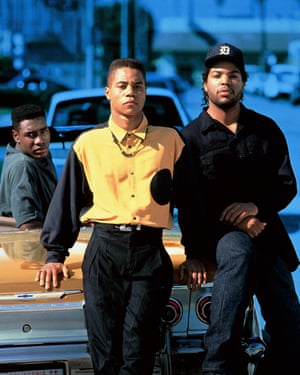
In Boyz N The Hood. Photograph: Allstar/Columbia
His mother was unable to afford a deposit on an apartment and they moved from place to place, living in cheap hotels or even in their car. At one point his mother had to lie to get into a shelter for abused women because the family hadn’t eaten for days. Rather than go “home”, Gooding would go to an after-school club. He channelled his energies into sports, gymnastics, breakdancing and eventually drama. “I’d gone through a lot of stuff by the time I was 18,” he says. “I was going to school and being, like, nothing was wrong and I had this wonderful life and my dad was a famous singer, but then going home and sneaking in the back of a hotel, and just really sordid stuff. When you tap into that, it gives you the colours you need as an actor.”
Some actors talk of digging deep within themselves to summon emotion; for Gooding, it seems to be the opposite. Performance is a release; keeping a lid on his emotions is the hard part. He’ll burst into tears as readily as laughter. “I have a lot of emotional content,” he admits, momentarily lapsing into a Bruce Lee impersonation. “It gives you all the colours of the rainbow right there at your fingertips. It’s a real good gift to have as a storyteller. I knew if there was an emotional moment needed in the script, I would bring a truth to it that no one else who was auditioning had. I knew I had this thing that nobody else had.”
At high school, he acquired a reputation as a “wonder kid”. At 16 he performed with a breakdancing crew at the 1984 Olympics (behind Lionel Richie at the closing ceremony); he later won a prize at the California Shakespeare festival for his Othello monologue, which he finished off with a backflip. The mother of a fellow student was a talent agent. She came to see his high school graduation performance and signed him up. “She said, ‘You can do comedy and drama the same.’”
As he narrates it, having a famous dad also fuelled Gooding’s sense of his own destiny, hence the autograph-practising in maths class: “I was going to be like him. This was just temporary. Even though I was around a lot of kids who were poor, I never saw myself as them. I saw myself as almost like stepping down among the common people before the king said, ‘Hey, this is my son’ and I got the crown again. Ain’t that funny? I’m just realising that now.” He’s sitting up on the sofa now, more animated and engaged. Occasionally, he slaps my leg to emphasise a point.
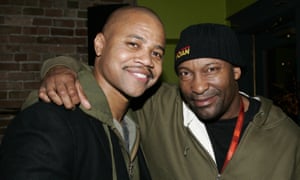
With director John Singleton. Photograph: Brian Ach/WireImage
Sure enough, he didn’t have to wait long for a break. John Singleton didn’t hesitate to cast him in his 1991 debut Boyz N The Hood, as a serious-minded kid sent to live with his authoritarian dad in deprived South Central Los Angeles. “I would say, ‘Don’t fucking smile unless I tell you to!’” Singleton tells me. “Because he’ll smile at the drop of a dime. He has a great big, shining personality. He’s funny. He’s a jokester. When things got really serious, he’d just drop his drawers and moon the crew. But he’s a very good actor, because going into that zone really makes him uncomfortable. When you see him play tense roles, he has this look on his face. His uncomfortableness is real.”
Boyz N The Hood was a breakout hit at a time when African American cinema was finally coming into its own, spearheaded by Singleton, Spike Lee and others. But Gooding didn’t make any more “African American” movies, despite many offers. “I said no to all of that. Because, in my head, I’m an actor who does all the parts, just like when I was doing Shakespeare in high school.”
Instead, he took more mainstream Hollywood roles: a navy corporal in A Few Good Men, sidekick to Paul Hogan in comedy-western Lightning Jack, a helicopter pilot in the Dustin Hoffman disaster movie Outbreak, all leading up to Jerry Maguire. “Now I’m moved away from the title ‘black actor’ and now I’m just an entertainer.
“I remember when I did Boyz N The Hood, everybody was like, ‘Yeah, but can he do comedy?’ Then I won for Jerry Maguire and they’re, ‘Yeah, but can he do drama?’” Not everyone was pleased about Gooding’s Oscar success. Spike Lee implied his performance, both in Jerry Maguire and at the Oscars, was in the tradition of servile African Americans ingratiating themselves with white audiences. “That kind of entertainment will keep you working,” Lee said. He also lampooned Gooding in his 2000 satireBamboozled, in which a black character dances on stage after winning an award and shouts, “Show me the money!”
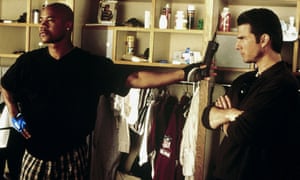
In Jerry Maguire. Photograph: Allstar/Tristar pictures
“Listen,” Gooding says, “I’ll never forget when I got a call from Denzel Washington to say congratulations on winning the Oscar. Oh, I cried. I got a bottle of champagne from Quincy Jones, who said, ‘You’re part of the family now.’ Oh, I cried again. Sidney Poitier reached out to me. These blew my mind. And then I got the message that Spike Lee gave an interview saying I’m evil… Do you take it personally? No. Of course it would look like that to him, because he was stigmatised as a ‘black’ film-maker. And yet we, theentertainers who were black, were celebrated in different genres and given different opportunities.” He points to young black film-makers such as Black Panther’s Ryan Coogler andMoonlight’s Barry Jenkins. “It will be interesting to see if they get put in the same box, like they did with the Singletons and Spike Lees, or if they’re accepted as just film-makers who have their ways to tell a story.”
Gooding arguably transcended racial boundaries in his pursuit of universal recognition, but he also missed opportunities. On the set of Jerry Maguire, director Cameron Croweadvised Gooding to work only with good directors, but Gooding turned swathes of them down: Steven Spielberg (for Amistad), Michael Mann (Collateral), Terry George (Hotel Rwanda), even the lead in Taylor Hackford’s Ray Charles biopic, for which Jamie Foxx won the best actor Oscar. “I had all these big directors offering me roles, and I read their scripts and said, ‘I don’t think this part is right for me.’ And what happens is, if you offend enough big directors, you get taken off their lists.”
The offers dried up and the turkeys piled up. Gooding went from bloated epics such as Pearl Harbor to kids’ comedies such as Snow Dogs to grownup would-be comedies such asBoat Trip (in which he played a heterosexual man who mistakenly signs up for a gay cruise). “For years I’ve been waiting for [Gooding] to just go away. If this dud comedy is any indication of the scripts he’s getting, we may not have to wait much longer,” said one catty but prophetic review of Boat Trip. Gooding sank even further into generic action movies with titles such as Ticking Clock, The Way Of War and Wrong Turn At Tahoe.
“Oh yeah, I did some real clunkers,” he admits.
Was it about the money?
“Not for me. For me, it was always about protecting the sanctity of that golden statue… Because I felt I needed to show people that I can do more, I can do better.” The responsibility of having an Oscar inhibited his choices, he seems to be saying, although turning down Hotel Rwanda and Ray to make Wrong Turn At Tahoe suggests the logic was somewhat flawed. He knows it now. “You say those things to yourself when what you should be saying is, ‘No, fucker, you get paid to practise, so whatever it is, take it and practise and get better!’” Then he adds, “You just reminded me of another one – I’m kicking my balls in this interview – I was offered Idi Amin in The Last King Of Scotland. And I said to myself, ‘I can’t do that. He’s a bad guy!’”
These days, he’s taking Crowe’s advice and working with good directors: Lee Daniels in The Butler, Ava DuVernay inSelma and, most prominently, Ryan Murphy for The People v OJ Simpson – playing exactly the kind of “bad guy” he’d once have turned down. Gooding didn’t hesitate when he got the call: “All I heard was ‘Ryan Murphy’. I didn’t even hear ‘OJ’. I was like, ‘What do I need to do?’” Gooding’s Simpson was a piece of stunt casting, arguably – he bears little physical or vocal resemblance to Simpson – but he threw himself into the role, embraced the psychopathic end of his spectrum, and put himself back on the radar. Making OJ also enabled a reunion with Singleton, who directed one of the episodes. On their first day together, Singleton says, he halted shooting and waved Gooding over. “We both went into the corner together and we both started crying. We started this shit together, man, and look at us now. We had a good cry. He’s my brother, man.”
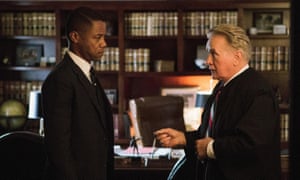
In Selma with Martin Sheen. Photograph: Allstar/Pathe
In addition, Gooding recently directed his first movie: Louisiana Caviar, a New Orleans-set drama he describes as “my answer to Crash or Pulp Fiction”. His experience on all those straight-to-DVD clunkers gave him an education in film-making. He hopes to do more of it, but for now, it’s Chicago.
There’s the sense of a new chapter for Gooding off-screen as well as on. He turned 50 at the beginning of this year. Last January, he divorced from his wife of 22 years, Sara Kapfer, with whom he has three children. A few months after that, Gooding’s father was found dead in his car, of natural causes. There is still no shortage of “emotional content” in his life, it seems.
“I felt like I turned 50 a long time ago,” Gooding says, “so when the actual number caught up with the experience I’ve had, it wasn’t as monumental as a lot of people want to make it. I step into many different lives, then I step back into this neutral place, and that neutral place turned 50, but mentally I’ve been there over and over again. Playing different characters, what it’s taught me is that experience gives you character, and when you survive something, it leaves an imprint on you that prepares you for the next something.”
Inside, he still feels like “the wonder kid”, he admits. “My mom said, ‘Don’t ever lose your smile.’ She said, ‘You have a God-given joy. Don’t ever let people take that from you.’ I understand the power in that now.
Carlos Alvarado Quesada promises ‘government for everybody’ after run-off where he trounced conservative who threatened to wind back tolerance
The centre-left’s Carlos Alvarado Quesada has decisively defeated a conservative Protestant singer in Costa Rica’s presidential runoff election by promising to allow gay marriage, protecting the country’s reputation for tolerance.
A former minister and fiction writer, Quesada, 38, had 61% of the vote with results in from 95% of polling stations, a far bigger lead than predicted by opinion polls that foresaw a tight race.
“My commitment is to a government for everybody, in equality and liberty for a more prosperous future,” he told thousands of cheering supporters blowing horns and waving Costa Rica’s red, white and blue flag.
“There is much more that unites us than divides us.”
“We didn’t win the election,” he said, adding that he had congratulated his opponent in a telephone call and, in another sign of Costa Rica’s cordial politics, promised to help him resolve the country’s problems.His rival, Alvarado Muñoz, a 43-year-old former TV journalist known for religious dance songs, quickly conceded, sinking to his knees, arms raised, in front of supporters, some of them crying.
The election had exposed divisions in the Central American tourist destination known for laid-back beach culture and pristine rainforests, but where some rural communities remain socially conservative.
It could also reflect the mood elsewhere in Latin America, whereelections are being held this year in several countries that have backed same-sex unions, provoking a conservative reaction.
Alvarado Quesada, until recently a minister in the outgoing government, will be the youngest president in the modern history of Costa Rica when he takes office in May.
Also known for his student prog-rock band, he used the campaign to appeal to his country’s centrist streak. His vice presidential candidate, Epsy Campbell, will be the country’s first Afro-Costa Rican to serve in that role.
Muñoz had vowed to restore what he called traditional values by preventing gay marriage and restricting women’s access to abortions.
In the campaign’s final debate, Alvarado Quesada called his opponent’s comments homophobic.
- Three bombers have been killed in Maiduguri, the Borno state capital
- This was revealed by the National Emergency Management Agency (NEMA)
- Four powerful explosions occurred in the town on Friday, March 30
The National Emergency Management Agency (NEMA) has confirmed the death of three bombers at Muna area of Maiduguri in an attempt to infiltrate the town in Friday, March 30.
The News Agency of Nigeria (NAN) reports that four powerful explosions occurred between 9: 00 and 9: 30 pm, sending terrifying echoes to many parts of the town.
NEMA’s northeast zonal coordinator, Mr Bashir Garga, who confirmed the incident, said that the blast occurred outside the town.
Maiduguri continues to suffer heavy attacks despite presence of security personnel. Photo source: Twitter
Garga disclosed that the bombers detonated Improvised Explosive Devices (IEDs) strapped to their bodies behind the security trench at Muna garage area in the outskirts of Maiduguri.
He said that terrifying echoes by the explosions caused some residents of the area to flee which made them to sustain injuries.
Garga added that the wounded were referred to hospital for treatment in Maiduguri.
“Details on the incident is still sketchy. It occurred behind the trenches and only the suici*e bombers were killed,”he said, adding that normalcy has been restored to the area.
NAN reports that Muna garage is prone to bomb attacks and the military had imposed a dusk to dawn curfew to secure the area. (NAN)
On Thursday, March 15, the Nigeria Police Force issued a red-alert on warning residents of Borno state against an impending attack by the Boko Haram terrorist group using vehicles loaded with explosives.
According to the police, the planned attack may result in heavy casualty if it succeeds since the insurgents are suspected to be targeting strategic locations of the city that are densely populated.
A statement by the police command in Borno state, signed by Ahmed Bello, an assistant commissioner of police, said the attack could take place in different parts of the city.